♛
Come, Bramah, give this world a second glance:
what will you gamble to save those you love?
Roll the dice, never think twice, grab your chance.

Jump the fence, throw the dice;
move your Queen, protect her twice—
un coup de dés!
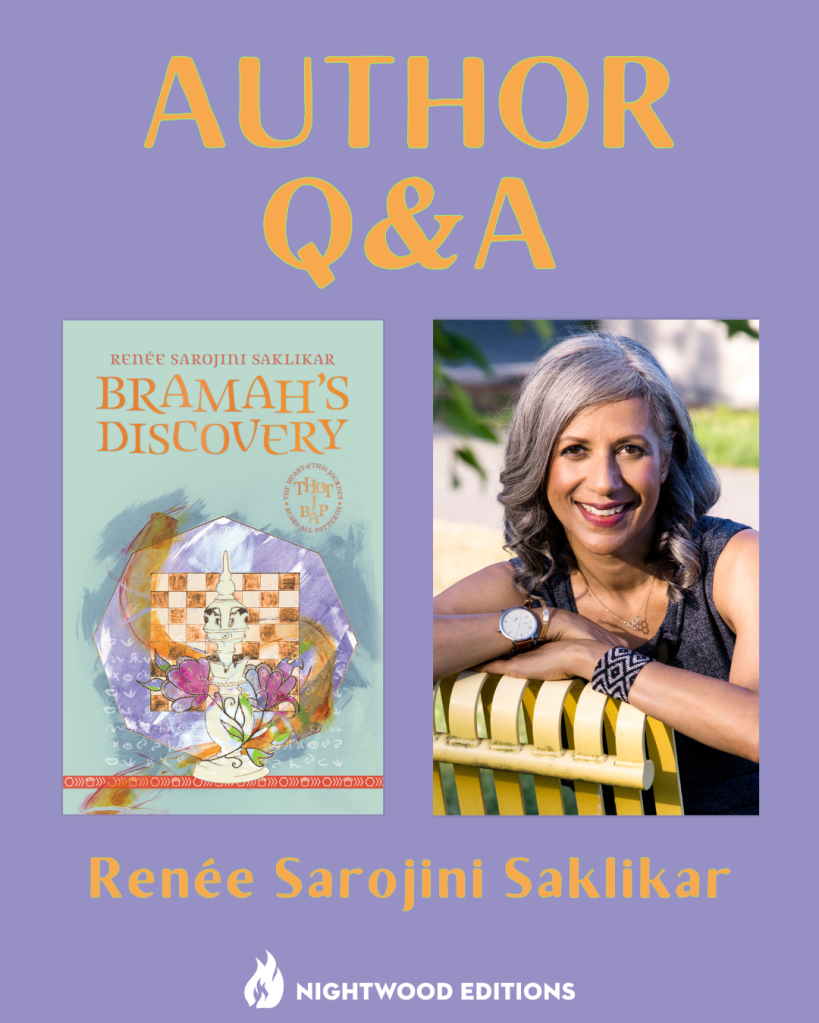
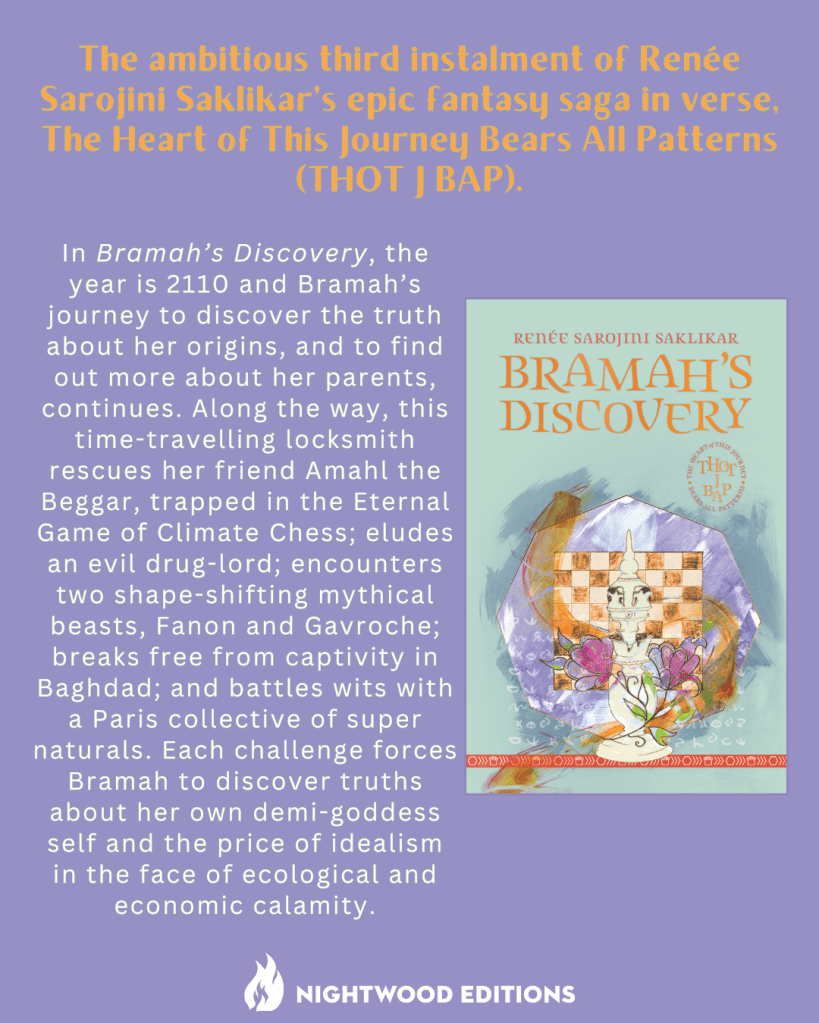
The ambitious third instalment of Renée Sarojini Saklikar’s epic fantasy saga in verse, The Heart of This Journey Bears All Patterns (THOT J BAP).
The year is 2110, and Bramah—the time-travelling locksmith and hero of the series—must rescue Amahl the Beggar, trapped in the Eternal Game of Climate Chess by a boss of the criminal underworld. With unexpected aid from a one-eyed guard, an oracle and two shape-shifting mythical beasts, Bramah must break free from captivity in Baghdad and battle wits with a Paris collective of supernaturals in order to save her friend. Each challenge forces Bramah to discover truths about her past, her origins as a demigoddess and the price of idealism in the face of ecological and economic calamity.
In Book Two, Bramah’s Quest, the year is 2087 and Bramah is back on a planet Earth ravaged by climate change and global inequality. She is on a quest to find her people, including the little boy Raphael, last seen at the end of Bramah and the Beggar Boy (2021).
Hailed as “brilliant and masterful, timely” (Kerry Gilbert), this long poem reclaims poetry forms such as blank verse, the sonnet, the ballad and the madrigal. Each page is a portal, connecting readers to the resistance of seed savers, craftspeople, scientists and orphans, all banded together to help save their world from eco-catastrophe and injustice.
Book One of THOT J BAP introduces Bramah, a time-travelling locksmith and her orphan-apprentice The Beggar Boy. Together they use cunning and magic to outwit the evil Consortium and join seed savers and outcasts in a world ravaged by climate change and global disorder.
This innovative work, published by Nightwood Editions, alchemizes fantasy, epic poetry, philosophy, climate change activism and the politics of gender and race. The poem is simultaneously a dystopian tale, a family saga, an exploration of language, and a meditation on good and evil.
—Meredith Quartermain, author of Lullabies in the Real World
“Reads like an investigative report (narratives masterfully constructed and reconstructed through multiple viewpoints) but sings from the page like an opera, replete with lyrical arias and a driving chorus.”
-Maria Reva, author of Endling
“Truly ambitious… This is the first epic poem of climate change.”
—Stephen Collis, author of A History of the Theories of Rain