 ♛
Myth, story, legend, fact—
               petals unfold together, apart.
Time’s stem split, turned back,
                                       the seasons, such riches, each twig and leaf,
threshold of discovery or precipice—
Book 3 of the THOT J BAP series, Bramah’s Discovery, is forthcoming Spring 2026!
The ambitious third installment of Renée Sarojini Saklikar’s epic fantasy saga in verse, The Heart of This Journey Bears All Patterns (THOT J BAP).
In Bramah’s Discovery, the year is 2110 and Bramah’s journey to discover the truth about her origins, and to find out more about her parents, continues. Along the way, this time-travelling locksmith rescues her friend Amahl the Beggar, trapped in the Eternal Game of Climate Chess; eludes an evil drug-lord; encounters two shape-shifting mythical beasts, Fanon and Gavroche; breaks free from captivity in Baghdad; and battles wits with a Paris collective of super naturals. Each challenge forces Bramah to discover truths about her own demi-goddess self and the price of idealism in the face of ecological and economic calamity.
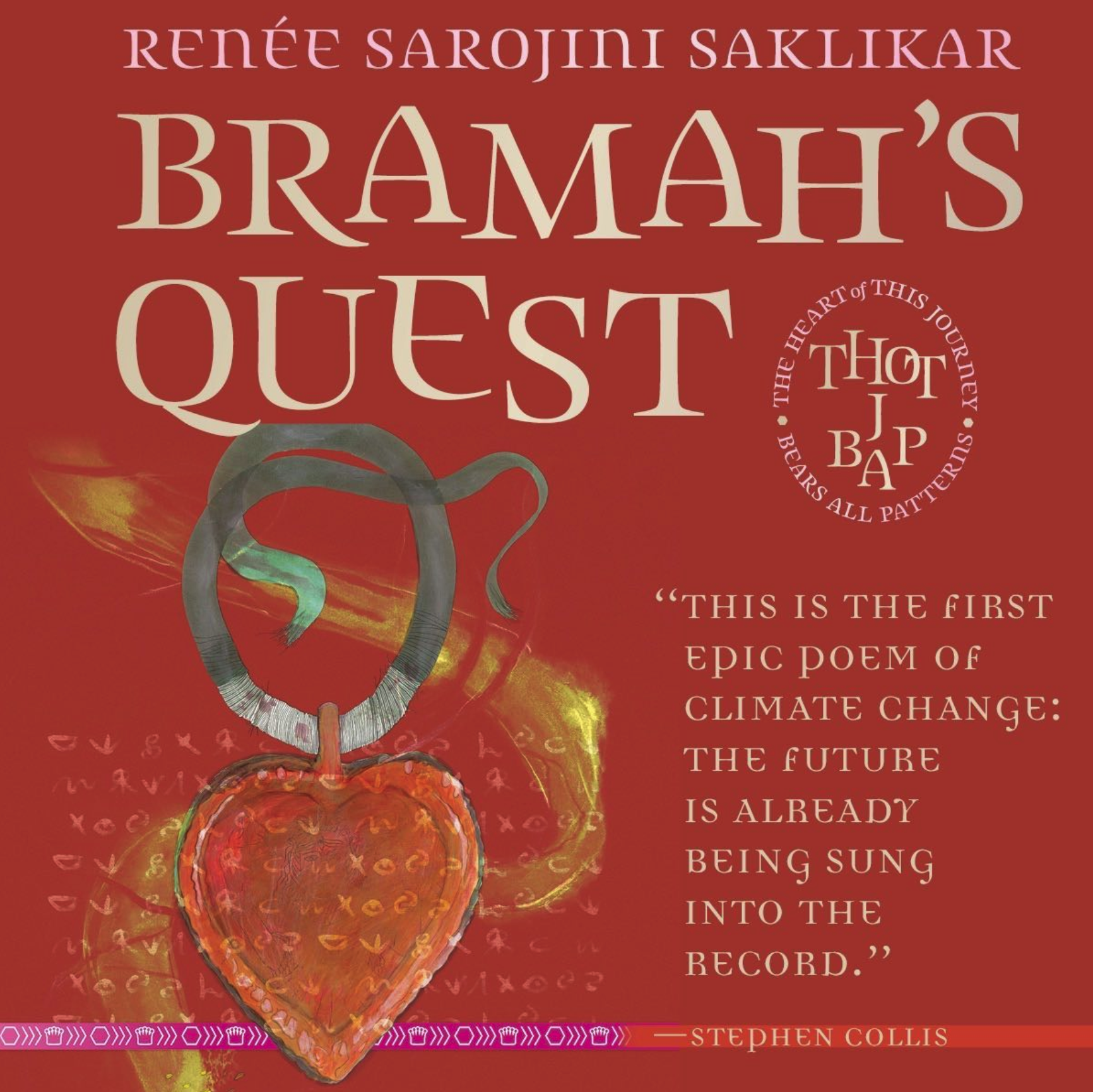
In Book Two, Bramah’s Quest, the year is 2087 and Bramah is back on a planet Earth ravaged by climate change and global inequality. She is on a quest to find her people, including the little boy Raphael, last seen at the end of Bramah and the Beggar Boy (2021).
Hailed as “brilliant and masterful, timely” (Kerry Gilbert), this long poem reclaims poetry forms such as blank verse, the sonnet, the ballad and the madrigal. Each page is a portal, connecting readers to the resistance of seed savers, craftspeople, scientists and orphans, all banded together to help save their world from eco-catastrophe and injustice.
Book One of THOT J BAP introduces Bramah, a time-travelling locksmith and her orphan-apprentice The Beggar Boy. Together they use cunning and magic to outwit the evil Consortium and join seed savers and outcasts in a world ravaged by climate change and global disorder.
This innovative work, published by Nightwood Editions, alchemizes fantasy, epic poetry, philosophy, climate change activism and the politics of gender and race. The poem is simultaneously a dystopian tale, a family saga, an exploration of language, and a meditation on good and evil.
“In Bramah’s Quest, Saklikar explores themes of the eternal battle between good and evil, female-centred mythology, and accelerated climate change… Inspiring [her] in creating this world is the late author Ursula K. Le Guin, who spoke of hard times coming and the need for writers to see alternatives to how we live and to imagine real grounds for hope.”






 THOT J BAP